What Does Dyslexia Really Look Like? A Guide to Noticing Early Signs
A child reads slowly.
Another child keeps forgetting letter sounds.
One writes a word correctly today and spells the same word differently tomorrow.
Another can explain a complicated story beautifully when speaking, but struggles to put the same ideas on paper.
And sometimes, a child simply starts saying, “I hate reading.”
Do these things automatically mean dyslexia?
No.
But they are worth noticing.
That is where the conversation about dyslexia should begin.
Dyslexia can look different from child to child. It can show up in reading, spelling, writing, remembering sequences, finding words, or learning the connection between letters and sounds. Some children show signs before they formally learn to read. Others become more noticeable only when schoolwork becomes more demanding.
The International Dyslexia Association's updated 2025 definition describes dyslexia as a specific learning disability involving difficulties with word reading and/or spelling, particularly accuracy, speed, or both. It also notes that the difficulties can vary depending on the language and writing system.
So the question is not:
“Does this child look dyslexic?”
The better question is:
“Am I noticing a pattern that deserves attention?”
First, let's put the numbers in perspective
Dyslexia is not rare.
The International Dyslexia Association has historically estimated that around 15 to 20% of the population may show some symptoms associated with dyslexia, although not everyone with these symptoms meets the criteria for a diagnosis.
Indian research also shows that learning difficulties are significant in school-age children.
A systematic review and meta-analysis covering 8,133 children across six Indian studies estimated the pooled prevalence of Specific Learning Disorders (SLD) at 8%, with estimates across individual Indian studies ranging from 3% to 10%. The review also reported that dyslexia, or reading disability, is the most common form of Specific Learning Disorder, accounting for about 80% of SLD.
These numbers should not be used to guess whether an individual child has dyslexia.
They tell us something else.
There are enough children struggling with reading and learning that noticing the signs early matters.
There is no single "dyslexic look". A child with dyslexia may be bright, curious, talkative, creative, athletic, quiet, shy, confident or any combination of these. Dyslexia does not mean a child is less intelligent. The National Health Service (NHS), England, specifically notes that dyslexia affects skills such as reading, writing and spelling, but does not affect intelligence. The challenge may become visible when a child has to work with written language.
Think of the difference between these two situations:
“Tell me what happened in the story.”
The child gives you a detailed answer.
Now ask:
“Read this paragraph and write what happened.”
Suddenly, the task becomes difficult. That difference is worth noticing.
Before Reading Begins, Listen to Language
Some signs can appear even before a child formally learns to read. You may notice difficulty with nursery rhymes, recognising rhyming patterns, remembering letter names, recognising letters in their own name, or persistent pronunciation difficulties. Yale's Dyslexia Center identifies these among possible early signs, while also highlighting family history of reading or spelling difficulties as an important clue.
For example, imagine a four-year-old who hears, "cat, bat, hat" but repeatedly struggles to notice that the words sound alike. Or you ask, "Can you think of a word that rhymes with cat?" and the child finds the task unusually difficult. This does not mean the child has dyslexia. Young children develop language skills at different rates. But if difficulties persist, they are worth noticing and keeping track of.
Phonological awareness, or the ability to notice and work with the sounds in spoken language, is an important foundation for learning to read. It includes skills such as recognising rhymes, identifying syllables, and noticing individual sounds within words. Research-based reading guidance recommends explicitly developing these skills as part of early reading instruction.
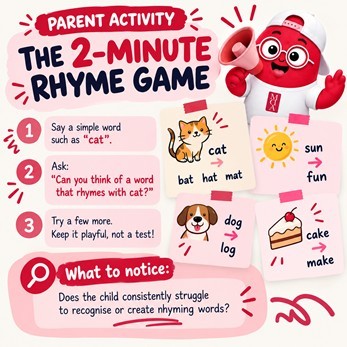
A 2-Minute Parent Activity
Try a simple rhyme game during everyday conversation. Say "cat" and ask your child to think of a word that sounds like it. Try "cat, bat, hat, mat" and make it playful rather than turning it into a test. The goal is not to get a score. It is simply to notice how comfortably your child hears and plays with sounds.
When Letters and Sounds Do Not Seem to Stick
Learning to read requires children to connect written letters with the sounds they represent. Some children may learn that "m" represents the /m/ sound and then need to relearn the same connection repeatedly. Others may know individual letters and their sounds but struggle to blend them together into a word.
Imagine showing a child the letters "c-a-t". They may correctly name all three letters, yet struggle to put the sounds together to read "cat". This does not necessarily mean there is a problem with memory or intelligence. It may indicate that the connection between sounds and letters is not becoming automatic in the way we would expect.
Evidence-based reading guidance recommends explicit instruction in phonological awareness and letter-sound relationships because these are foundational skills for reading development.
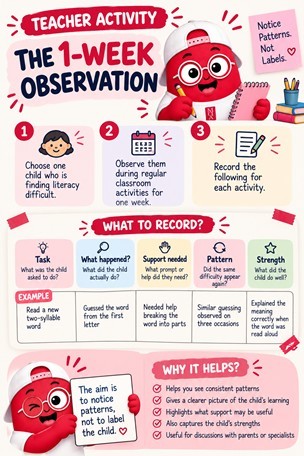
A 1-Week Teacher Activity
For one week, observe three things when a child is working with letters and words. Can the child identify the letter? Can they produce its sound? Can they use that sound when reading a word? Instead of writing "bad at reading", record something specific such as, "Recognises b, but often cannot recall /b/ without prompting." Specific observations help teachers identify patterns and decide what support may be useful.
When Reading Stays Slow, Effortful or Unpredictable
One of the clearest things to notice is not necessarily how many mistakes a child makes, but how much effort reading requires. A child may read a familiar word correctly one day and struggle with it the next. They may guess an unfamiliar word based on its first letter or replace one word with another that looks similar.
For example, the word on the page might be "horse", but the child reads "house". Or they see a word beginning with "fr" and guess a word rather than working through the sounds. Yale's Dyslexia Center identifies slow or effortful reading, difficulty reading unfamiliar words, guessing words instead of sounding them out, and avoiding reading aloud among possible signs of dyslexia during the school years.
The important thing is to look for a pattern. One reading mistake tells us very little.
When Spelling Seems Much Harder Than It Should
Spelling can be another window into how a child is processing written language. A child may spell the same familiar word differently several times, omit sounds, rearrange letters or continue to struggle with common spelling patterns despite repeated practice and instruction.
Imagine a child writing "because" as "becos" one day, "becaus" the next and "beacuse" another time. The useful observation is not simply that the child "cannot spell". The more useful observation is that the spelling of a familiar word remains inconsistent despite repeated exposure.
The International Dyslexia Association's current definition specifically includes difficulties with word reading and/or spelling, particularly in accuracy, speed or both. Looking at spelling therefore forms an important part of understanding a child's literacy profile.
When Writing Hides What the Child Actually Knows
Sometimes the difficulty is not understanding. It is getting the understanding onto paper.
A child may be able to explain a science concept beautifully when speaking but produce only a few simple words when asked to write about it. They may know the answer but spend so much mental effort thinking about spelling, handwriting and sentence construction that very little of their actual knowledge appears on the page.
This can easily lead adults to make the wrong assumption. A teacher may look at a short written response and think, "The child does not understand the topic." However, when the same child explains the answer verbally, a completely different picture emerges.
This is why dyslexia needs to be viewed holistically. Reading and writing difficulties can interact with language, confidence, classroom participation, and academic performance. Looking only at the finished worksheet can sometimes hide what a child actually knows.
"But They Are So Good at Speaking!"
This is one of the most important things for adults to understand.
A child can have strong general knowledge, a rich spoken vocabulary, excellent storytelling skills, curiosity, and strong problem-solving abilities while still finding reading difficult. Yale's Dyslexia Center notes that some children with dyslexia may demonstrate strengths such as curiosity, imagination, understanding of new concepts, puzzle solving, and comprehension when information is presented orally.
Consider a child who can listen to a story and tell you exactly what happened, including details about the characters and what they might do next. Ask the same child to read the story independently, and suddenly the task becomes difficult.
That difference matters.
Instead of asking only, "What can this child not do?", we should also ask, "What can this child do when reading and writing are taken out of the picture?" Both answers are important when building a complete picture of the learner.
When Behaviour Becomes the First Clue
Sometimes literacy difficulty does not initially look like a literacy difficulty at all.
A child who is repeatedly asked to read aloud may begin avoiding reading. A child who finds written work exhausting may sharpen their pencil very slowly, ask to go to the bathroom, or suddenly become distracted whenever a worksheet comes out. Another child may become restless or disruptive, while someone else may become unusually quiet.
None of these behaviours automatically indicate dyslexia. But they can tell us that something about the task may be difficult.
Instead of asking, "Why is this child refusing to read?", it can be more useful to ask, "What happens immediately before the child refuses to read?". Looking at what triggers the behaviour can reveal patterns that might otherwise be missed.
This is particularly important because repeated academic difficulty can affect how children feel about themselves as learners. Noticing the difficulty early gives adults an opportunity to provide appropriate support rather than allowing frustration to become the child's identity.
Look at the Whole Child, Not Just the Notebook
Dyslexia is not simply a collection of spelling mistakes or reversed letters. A more useful picture comes from looking across different parts of a child's learning experience.
Consider language, reading, spelling and writing together. Does the child struggle with rhymes, pronunciation or finding words? Is reading unusually slow or hesitant? Do spelling errors remain persistent despite instruction? Is there a noticeable difference between what the child can explain verbally and what they can produce in writing?
Also look beyond literacy. Does the child struggle with sequences such as days of the week or months? Do multi-step instructions become difficult? Does the child become particularly frustrated, tired or avoidant around reading and writing? And just as importantly, what does the child do well?
The NHS lists difficulties with reading, writing, spelling, remembering information, planning and organising among possible signs associated with dyslexia in children. But no single sign should be used in isolation.
A holistic view asks both questions:
Where is this child struggling?
Where is this child thriving?
Both matter.
What About Children Learning More Than One Language?
This question is especially important in India, where many children grow up using more than one language.
A child may speak Marathi at home, study primarily in English at school, and encounter Hindi in other parts of their environment. Their experience of learning to read can therefore be different across languages.
The International Dyslexia Association notes that dyslexia can vary depending on the language and writing system involved. Assessment needs to take these characteristics into account rather than assuming that literacy development looks identical across languages.
This is particularly relevant in the Indian context. The work of Maharashtra Dyslexia Association (MDA) includes the Dyslexia Assessment for Languages of India (DALI), reflecting the importance of considering Indian languages when understanding literacy difficulties.
So difficulty reading English alone does not automatically mean dyslexia. Language exposure, quality of instruction, opportunities to practise, and development across languages all need to be considered.
The Family History Clue
Sometimes an important clue comes from the family itself.
Ask a parent or caregiver, "Did anyone in the family struggle with reading or spelling?".
You may hear stories such as, "I hated reading aloud in school.", "I always needed extra time for written work." or "I was terrible at spelling, but nobody knew why."
A family history of reading and spelling difficulties can be relevant when considering dyslexia. Yale's Dyslexia Center recommends paying attention to family history alongside a child's language and literacy development. But family history is a clue, not a diagnosis. It is one piece of the larger picture that parents, teachers and professionals can consider.
Start With Notice
Noticing is not about finding a label. It is about paying closer attention to a child's learning journey. A missed sound, a repeated spelling error, slow reading, or a sudden dislike of books may seem small on its own, but patterns can tell us when a child may need more support. The earlier we notice, the earlier we can understand what is making learning difficult and respond in the right way. Every child brings their own strengths, abilities, and ways of learning to the classroom and home.
This Dyslexia Awareness Month, let us look beyond the mistakes on the page, ask better questions, and remember that noticing is not diagnosing. It is the first step towards understanding, supporting and helping every child learn with confidence.

Sources and further reading
- International Dyslexia Association, 2025 Definition of Dyslexia — The current IDA definition covering reading, spelling, accuracy, speed, language, writing systems and early support.
- Yale Center for Dyslexia, Signs of Dyslexia — Early signs across preschool, kindergarten, primary school and adolescence.
- Yale Center for Dyslexia, Suspect Dyslexia? Act Early — Guidance on early observation, family history and early identification.
- NHS, Dyslexia in Children — Child-friendly overview of possible signs and clarification that dyslexia does not affect intelligence.
- Indian systematic review and meta-analysis of Specific Learning Disorders — Six studies involving 8,133 Indian children, with a pooled SLD prevalence of 8%.
- Institute of Education Sciences, Foundational Reading Skills — Evidence and recommendations around phonological awareness, letter-sound relationships, and foundational reading instruction.
- National Institute of Child Health and Human Development (NICHD), National Reading Panel findings — Evidence supporting systematic instruction in phonemic awareness, phonics, fluency, vocabulary and comprehension.
- Maharashtra Dyslexia Association — MDA's work in assessment, remediation, counselling, training, research, advocacy and educational support.
- MDA Teacher Workshops — MDA's focus on early identification, intervention, screening and teacher support.
- MDA, Dyslexia Assessment for Languages of India — Information on DALI and the Indian language context of dyslexia assessment.