From Noticing to Understanding: Why Early Identification Matters
A child struggles to read.
A teacher notices that the same mistakes keep appearing.
A parent starts wondering, "Is this just a phase?"
This is often where the journey begins.
And this is an important distinction: early identification is not about putting a deadline on a child. It is about opening the right door sooner.
A child does not need to have everything figured out by a certain age. They do not need to be labelled because they read slowly in Class 2 or struggle with spelling in Class 4. What matters is recognising persistent patterns, understanding what is behind them, and connecting the child with the right support.
The International Dyslexia Association's 2025 definition makes this point particularly well. It states that identification and targeted instruction are important at any age, while also noting that language and literacy support before and during the early years of education can be particularly effective.
So, think of early identification not as a race. Think of it as turning on the lights. Once we can see what is happening, we can decide what to do next.
Why does identification matter?
Specific Learning Disorders are not rare.
A systematic review and meta-analysis of six Indian studies involving 8,133 children estimated the pooled prevalence of Specific Learning Disorders in India at 8%, although the researchers also highlighted the limited number of high-quality, population-based studies available in India.
The same review found that individual studies reported widely different estimates, ranging from about 1.6% to 16.5%. This variation is one reason prevalence figures should be interpreted carefully rather than treating one number as the exact number of children affected across India.
What the data does tell us is that learning difficulties are significant enough to warrant systems for identification, assessment and support.
And research tells us something else.
A meta-analysis of 53 intervention studies involving 6,053 students from kindergarten to Grade 5 found a statistically significant positive effect of reading instruction on standardised reading outcomes for students with or at risk for dyslexia.
Another meta-analysis covering 25 intensive early reading intervention studies found positive effects for struggling readers in kindergarten through Grade 3.
Identification helps move the conversation from:
"Something is wrong with this child."
to:
"What exactly is this child finding difficult, and what support will help?"
That is a very different conversation.
Identification is not the same as diagnosis
This distinction is important.
A teacher can notice.
A parent can notice.
A school can screen.
But noticing a pattern is not the same as diagnosing dyslexia.
The IDA explains that dyslexia involves persistent word-reading and/or spelling difficulties even when instruction has been effective for the individual's peers. It also emphasises that identification should consider the child's language and literacy development, instruction, and response to support.
This is why a professional assessment looks at much more than whether a child can read a paragraph.
It may examine areas such as reading, spelling, writing, phonological processing, language, and other relevant skills.
MDA's assessment resources describe a comprehensive assessment battery that can include measures of cognitive abilities, phonological processing, oral reading, word identification, spelling and writing, depending on the child's age and needs.
The purpose is not to collect test scores for the sake of collecting test scores.
The purpose is to understand the learner.
What actually happens after someone notices?
This is where the process can feel confusing for families.
A parent may know that something is not quite right, but have no idea what happens next.
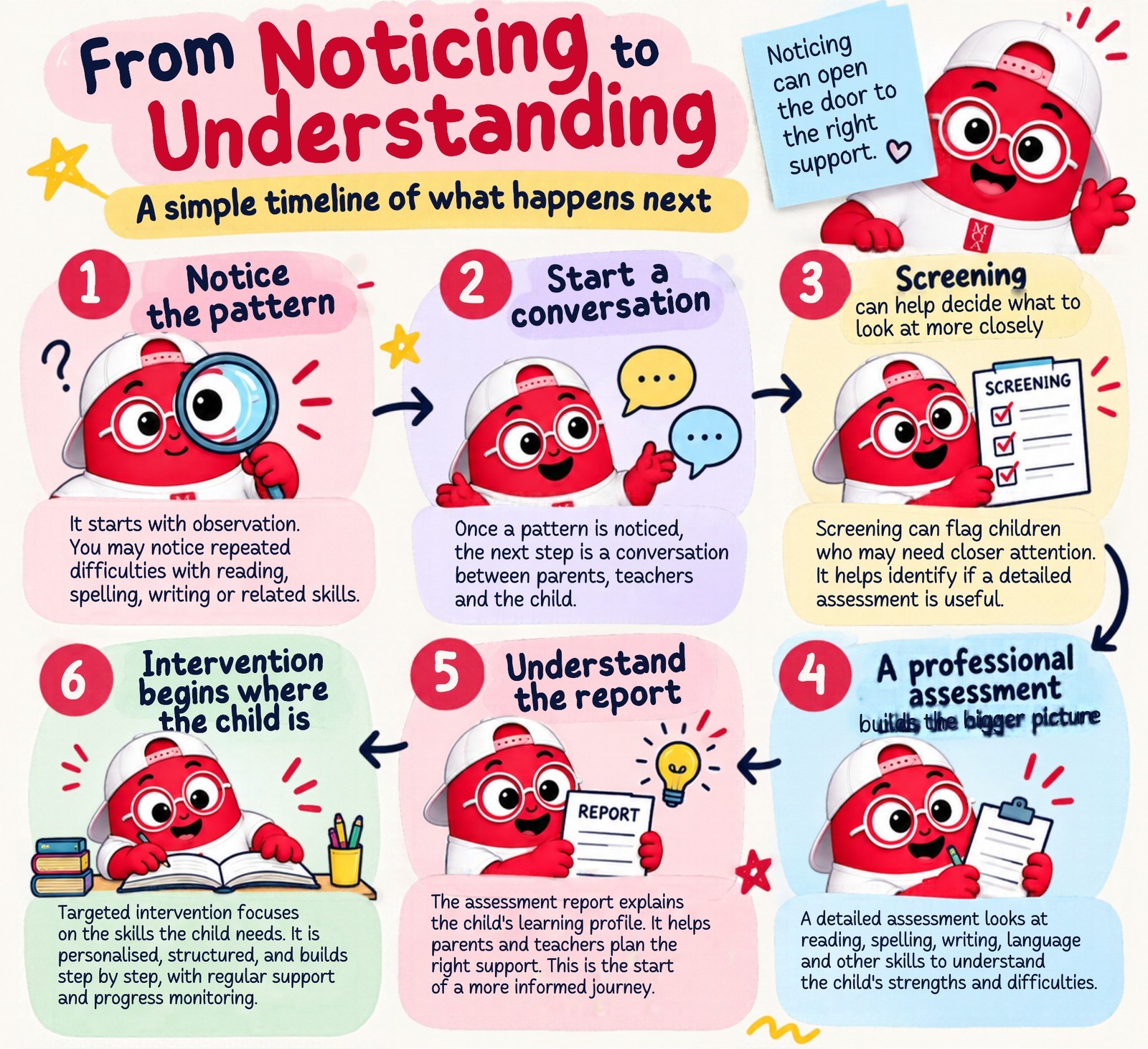
So, what does "early" really mean?
It does not mean:
"Diagnose by age seven."
It does not mean:
"Every reading mistake needs an assessment."
And it certainly does not mean:
"There is something wrong with my child."
It means:
Don't ignore a persistent pattern simply because you hope it will disappear.
A child who receives support early may have more opportunity to build foundational literacy skills before academic demands become more complex. Research on reading interventions shows positive effects for children who are struggling with reading, particularly in the early elementary years. But early does not mean only early childhood.
Understanding a learner at 14 can still be valuable.
Understanding a learner at 24 can still be valuable.
There is no expiry date on understanding how someone learns.
From a red day to a longer conversation
October's dyslexia awareness activities give us a reason to talk.
MDA's World Dyslexia Awareness Month campaign brings together awareness, education, and community participation with initiatives such as webinars, school outreach, and public campaigns including #GoRedForDyslexia.
But the conversation should not end when the red comes down.
A red post can make someone stop scrolling.
A webinar can answer a question.
A teacher workshop can change what happens in a classroom.
An assessment can explain a pattern.
Intervention can build a skill.
A supportive teacher can change a child's experience of school.
And a parent who understands that dyslexia is not laziness can change what a child hears at home.
That is the real purpose of awareness.
Not simply to notice dyslexia.
To know what to do after noticing it.
The goal is not a faster label. It is better support.
A child's journey does not become easier simply because we identify a name for the difficulty.
It becomes more manageable when the adults around that child understand what the difficulty means, recognise their strengths, and know how to respond.
That is why identification matters.
It can turn confusion into information. Information into a plan. A plan into targeted support. And support into a better learning experience.
MDA's mission is to promote the rights of individuals with Specific Learning Disability through diagnostic and remedial services, advocacy, research, and capacity building. Its wider work brings together assessment, remediation, counselling, professional training, school support, research and advocacy.
The journey may start with one simple observation:
"I've noticed something."
The important part is what happens next.
Notice. Understand. Support.
Because when we understand how a child learns, we can begin to change how the world teaches them.