What If We Didn't Catch It Early? It's Never Too Late to Understand How You Learn
Because the right support can make a difference at any age.
Have you ever looked back at your school years and wondered why reading was always harder for you? Or why you could explain an answer perfectly, but struggled to write it down? Maybe you were called careless, told to try harder, or compared with classmates who seemed to pick things up more easily.
Perhaps nobody realized that you were struggling with dyslexia. Perhaps the signs were there, but nobody knew what to look for. Or perhaps you are a parent who has only recently begun to understand why your child finds certain aspects of learning difficult.
Whatever your story, there is something important to remember: not identifying dyslexia early does not mean that the opportunity to get support has passed.
Early identification can help children receive support sooner. However, people who discover dyslexia during their teenage years or adulthood can also learn more about how they process information, find strategies that work for them, and make sense of experiences that may have felt confusing for years.
We cannot go back and change what was missed. But we can change what happens next.
First, let's talk about what might have been missed
Dyslexia does not always look the same in every child. Some children find reading difficult from the beginning. Others learn to manage for a while, perhaps because they have developed their own ways of coping, or have received support without anyone identifying the underlying difficulty.
As academic demands increase, however, keeping up may become harder. There is more reading, more written work, more independent learning, and greater pressure to complete tasks quickly.
A child who once managed reasonably well might begin to struggle with longer texts, spelling, written assignments or examinations. A teenager may understand a subject, but find it difficult to express their knowledge in writing. An adult may have learnt to work around their difficulties for years, only to find that a new job, or a change in responsibilities brings them to the surface again.
Sometimes, the difficulty is mistaken for carelessness, lack of effort, or poor time management.
But what if the person has been trying their best all along?
Dyslexia is a lifelong learning difference that primarily affects reading and spelling. Its impact can change with age, experience, and the demands placed on a person. Recognizing it later does not make the difficulty any less real.
The International Dyslexia Association estimates that around 1 in 5 people have dyslexia, although experiences and support needs vary considerably. Many people may not have been identified during their school years.
If a child wasn't identified early, what can we do now?
Perhaps a child has moved through several school years without anyone recognizing their reading or spelling difficulties. Maybe they have been working harder than their classmates, but still finding it difficult to keep up.
The first step is not to worry about how much time has passed. It is to look at what the child needs today.
For parents and caregivers
It can be difficult to discover that a child has been struggling without receiving the right support. Parents may wonder whether they should have noticed sooner. Teachers may look back at earlier difficulties and question what could have been done differently.
Instead of getting caught up in what might have happened, focus on what can happen next.
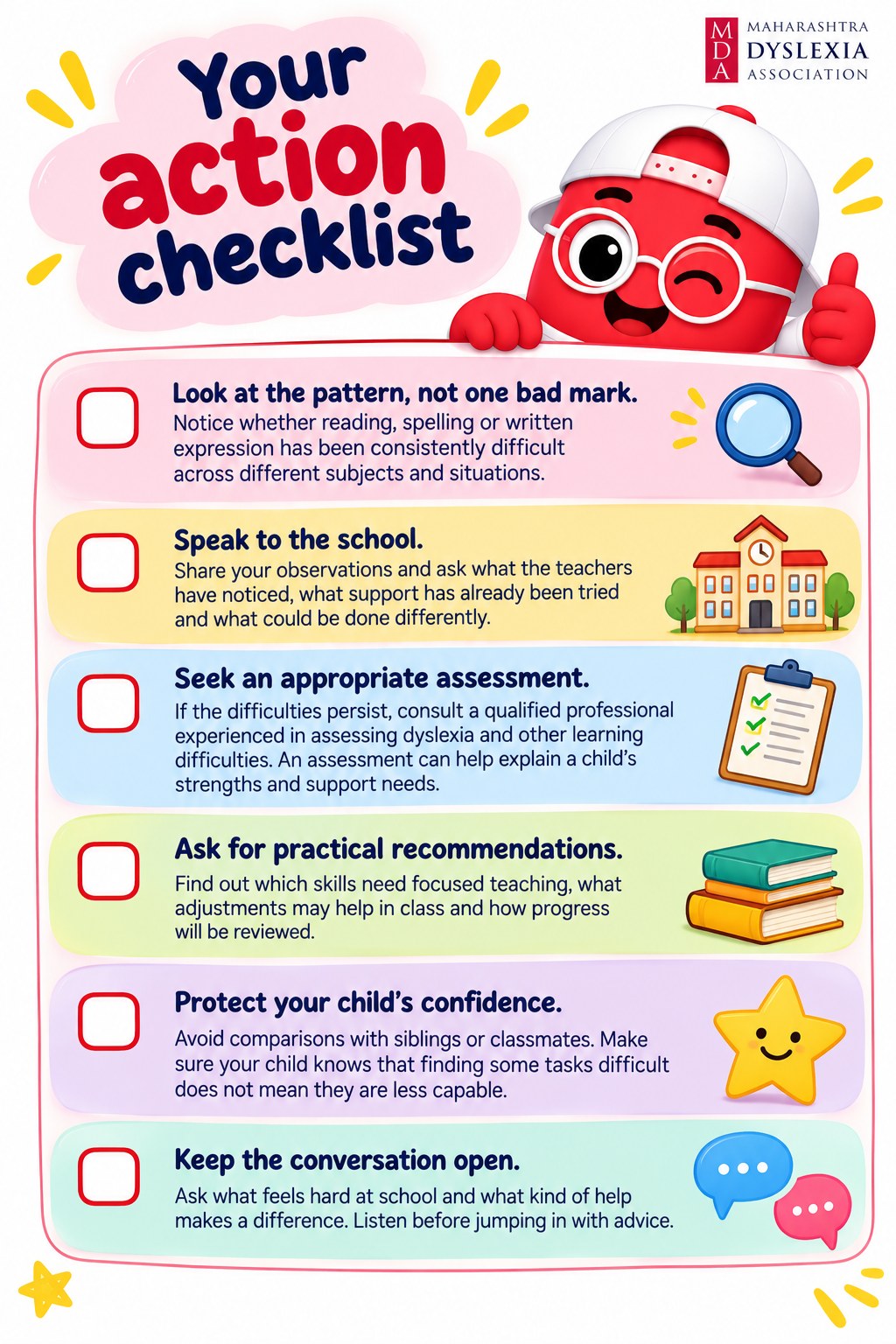
Remember, you do not need to solve everything at once. One conversation with a teacher, or one appointment with a qualified professional can be a useful place to begin.
What if the child is already a teenager?
By adolescence, the challenges may look a little different.
A teenager may have developed ways to hide their difficulties. They might avoid reading aloud, take much longer to finish assignments, depend heavily on someone else to proofread their work, or feel anxious about examinations.
Some teenagers may even begin to believe that they simply aren't good at academics.
This is a particularly important time to listen. Teenagers are developing their independence, figuring out who they are, and comparing themselves with their peers. Discovering that they need support can feel uncomfortable, especially if they have spent years trying to keep up without drawing attention to their difficulties.
What parents and teachers can do

Most importantly, give teenagers a say in the support they receive. The goal is not simply to help them manage schoolwork. It is to help them understand themselves and develop the skills to advocate for their own needs.
If you recognize yourself in some of these descriptions, you do not need to jump to conclusions. The aim is to understand what is making particular tasks difficult, and explore the right next steps.
A few terms that may help along the way
If you or someone you know is exploring dyslexia later in life, you may come across some unfamiliar terms. Here are a few worth knowing.
Screening: A preliminary process that helps identify whether someone may need further assessment. It can indicate a possibility, but it does not confirm dyslexia.
Diagnostic assessment: A more detailed evaluation of a person's learning history, reading, spelling, and other relevant skills. It helps a qualified professional understand the nature of the difficulties and identify appropriate support.
Phonological and Phonemic awareness: The ability to recognize and work with sounds in spoken language. This includes hearing the individual sounds in a word and understanding how they fit together.
Decoding: Working out an unfamiliar written word using knowledge of letters, sounds, and spelling patterns.
Structured literacy: An explicit, systematic approach to teaching reading and spelling. Skills are taught in a planned sequence, with practice and review suited to the learner's needs.
Assistive technology: Tools that help people access information or complete tasks. Examples include text-to-speech software, which reads digital text aloud, and speech-to-text software, which converts spoken words into written text.
Accommodations: Adjustments that help a person access learning, or demonstrate what they know. These might include additional time, accessible formats, or appropriate technology, depending on the person's needs and the rules of the relevant institution or examination.
You do not need to learn every term at once. Start with the ones that help you understand your own or your child's needs, and ask a qualified professional to explain anything that is unclear.
Who can help? Where can you begin?
You do not have to figure out the next steps alone. Depending on your age, location and needs, different organizations and professionals can help you explore assessment, learning support, and practical strategies.
In India
Maharashtra Dyslexia Association (MDA): MDA provides assessment, remedial programs, counselling, parent guidance, professional training, and school support. Its resources can help families understand learning difficulties and explore support options.
Visit: mdamumbai.com
Qualified assessment professionals: Look for a professional with appropriate qualifications and experience in assessing dyslexia and specific learning difficulties, including experience relevant to the person's age and language background. Ask what the assessment covers and whether it will provide practical recommendations.
Schools, colleges, and learning support teams: If the person is studying, speak to the institution about learning support, accessible teaching materials, and any applicable examination accommodations. The process and eligibility requirements may differ across institutions and examination boards.
Counsellors and mental health professionals: If late identification brings up frustration, anxiety, or questions about self-confidence, a suitably qualified professional can help the person work through these feelings alongside practical learning support.
Additional information and guidance
- International Dyslexia Association: Information on dyslexia, evaluation and evidence-informed support.
- British Dyslexia Association: Guidance for adults, parents, educators and employers, including adult dyslexia screening resources.
These organizations provide information and guidance, but the availability of services, assessment routes, and eligibility requirements will depend on where you live and your individual circumstances.
Early identification is an opportunity, not a deadline
When we talk about identifying dyslexia early, the goal is to help children receive the right support as soon as possible. The earlier we recognize a difficulty, the sooner we can respond to it.
But early identification should never become a reason to give up on someone who was identified later.
A child who receives support in primary school, a teenager who begins to understand their learning needs, and an adult who finally finds an explanation for lifelong difficulties, all deserve the opportunity to move forward with the right support.
We may not always catch the signs early. We may not always know what to look for. What matters is what we do when we begin to understand.
This World Dyslexia Awareness Month, let us keep learning, keep listening, and keep making room for different ways of learning. Let us help children who need support today, teenagers finding their way, and adults who are only now beginning to understand their own experiences.
The point of awareness is not simply to recognize dyslexia sooner. It is to make sure that, whenever it is recognized, support is still possible, understanding is still valuable, and it is never too late to begin.